
What are the Five Chinese “Elements”
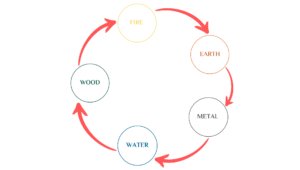
The five Chinese “elements,” or five phases, are: wood (mu 木), fire (huo 火), earth (tu 土), metal (jin 金), and water (shui 水).
Wood (mu 木) represents the awakening of the yang principle, hence its vigorous, expansive, and self-confident nature.
Fire (huo 火) is the phase in which the yang principle is already established and dominant, hence an equally self-confident and communicative nature, but also relaxed, especially on the human level.
Earth (tu 土) is a neutral “element” by nature, neither yin nor yang, and has to do with a more down-to-earth, methodical, objective, and hardworking spirit.
Metal (jin 金) represents the cosmic moment in the opposite direction to wood (mu 木). If the latter is centrifugal expansion and the vigor derived from the awakening of yang, in the metal (jin 金) “element” or phase, there occurs as if a vigorous cosmic “contraction” derived from the awakening of the yin principle, which by nature is centripetal. Metal (jin 金) suggests rigidity, inflexibility, and resilience.
Finally, in the water (shui 水) phase, the yin principle has already become predominant and hence a more relaxed, intelligent, and flexible nature, progressing and leading more through vision than effort, more through emotional communication than aggressiveness or effort.
The five “elements” should always be seen in a circular sequence, without beginning or end, and not as separate entities or parcels.